
Access Bryan County Divorce Decree Records
Bryan County divorce decree records are filed and maintained by the Court Clerk at the District Court in Durant, Oklahoma. This office stores all family law case files, including final divorce decrees, dissolution orders, and custody documents for cases in the 19th Judicial District. You can search Bryan County divorce records online at no cost through the Oklahoma State Courts Network, or visit or contact the Durant courthouse to request certified copies of divorce decree documents. Everything you need to know about finding these records is covered below.
Bryan County Divorce Decree Overview
Bryan County Court Clerk in Durant
The Bryan County Court Clerk in Durant is the official keeper of all district court records for the county. This includes every divorce decree, dissolution filing, and family law document filed since Oklahoma statehood in 1907. Bryan County was part of the Choctaw Nation before statehood, and the county's name honors William Jennings Bryan, the politician and orator. The Choctaw Nation of Oklahoma remains an active presence in the area and maintains historical records that may supplement courthouse files for pre-statehood research.
The Bryan County District Court on OSCN links to the docket search system and court contact information. Bryan County is part of the 19th Judicial District. The Court Clerk processes in-person requests, mail requests, and some phone inquiries for divorce decree copies. Durant is the county's largest city and serves as the commercial and civic center of the area. The courthouse is accessible and staff can typically handle same-day copy requests for in-person visitors who come with the right information.
| Office | Bryan County Court Clerk |
|---|---|
| Location | Durant, Oklahoma |
| County | Bryan County |
| Judicial District | 19th District |
| Online Search | OSCN Docket Search |
| County Website | bryan.okcounties.org |
| Choctaw Nation | choctawnation.com |
The Bryan County government website provides current contact details and office hours for the Court Clerk in Durant, where divorce decree records are maintained.
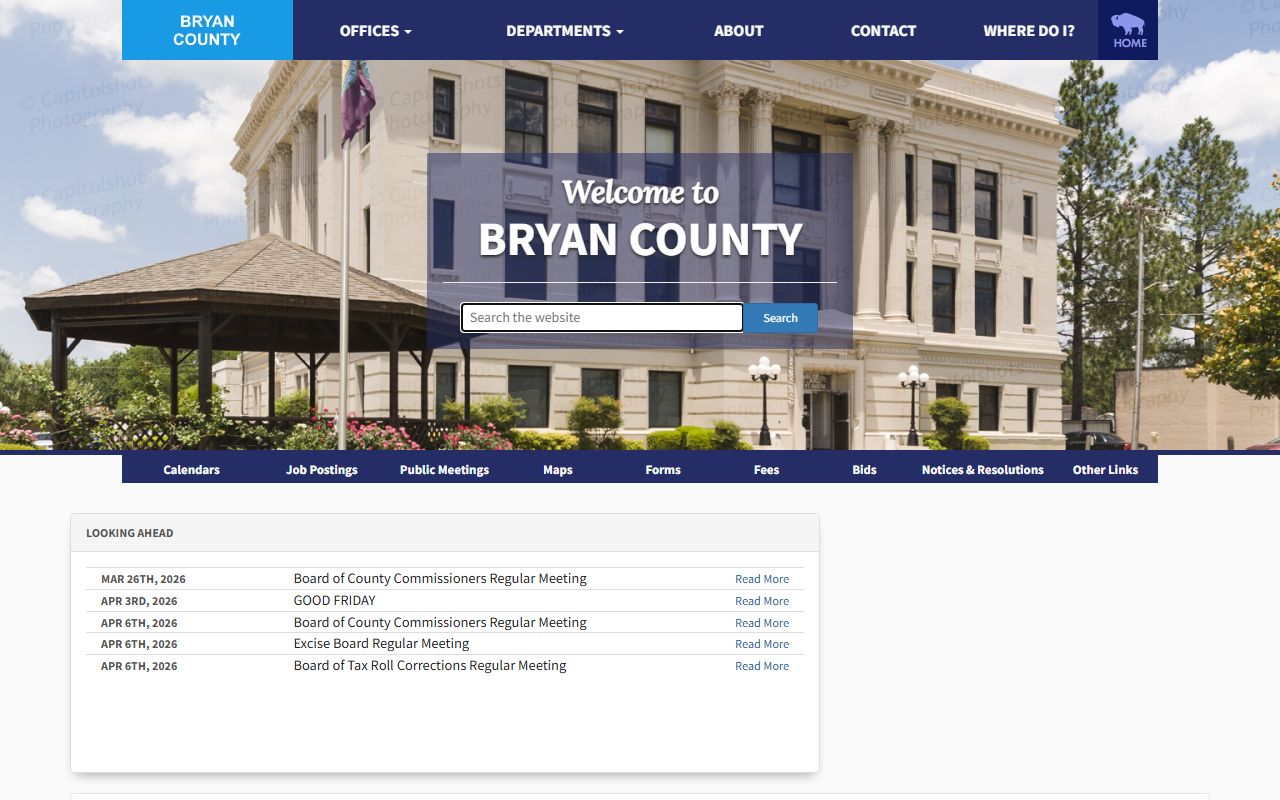
The county website shown above is the place to verify hours and confirm how to submit a divorce decree request before visiting or mailing to the Bryan County Court Clerk.
How to Search Bryan County Divorce Records
Start your search at the OSCN docket search tool. It is free and covers all 77 Oklahoma counties, including Bryan. Select Bryan County, type in one or both parties' names, and filter by FD case type to limit results to divorce filings. You will see the case number, party names, docket events, and case status. The actual text of the divorce decree does not appear online, but you get the case number and enough information to confirm the right case before requesting a copy from the Court Clerk in Durant.
In-person requests at the Durant courthouse are the fastest route to getting copies. Bring your photo ID, both parties' full names, and the approximate year the divorce was filed. If you have the FD case number, bring that too. Staff can pull the file and make plain or certified copies while you wait. Durant is easy to reach from most parts of southern Oklahoma, and the Court Clerk's office is inside the county courthouse.
For pre-statehood records or very early Oklahoma divorce filings in Bryan County, the Choctaw Nation of Oklahoma maintains historical archives from the era when this area was Choctaw Nation territory. Those records can help trace family histories that cross the pre-statehood and post-statehood divide. The Oklahoma Historical Society also holds microfilmed court documents from Bryan County going back to early statehood.
Mail requests are accepted by the Court Clerk. Write a letter with both parties' full names, the approximate year of the divorce, the FD case number if you have it, your return address, and payment by check or money order. Add a stamped return envelope. Allow one to two weeks for processing. Call the office before sending to confirm current fees and verify that the information you have is sufficient to locate the record.
Note: Bryan County divorce records are public. You do not need to be a party to the case to request a copy. Social security numbers and certain financial documents get redacted from copies provided to non-parties, but the core decree is accessible to anyone.
Bryan County Divorce Decree Copy Fees
The Bryan County Court Clerk charges copy fees consistent with Oklahoma's standard rate schedule. Plain copies are $1.00 for the first page and $0.50 for each additional page. Certified copies carry the official court seal and cost more, with certification adding between $0.50 and $5.00 to the total. If staff must search for the file without a case number, expect a search fee of $5.00 to $15.00. Certified copies are the appropriate choice when you need the document for legal purposes such as name changes, estate matters, or remarriage in another state.
For mail requests, send a check or money order made payable to the Bryan County Court Clerk. Do not send cash. Confirm the exact amount before mailing by calling the office. In-person payments are usually accepted by cash, check, or money order at the courthouse in Durant. If you need a certified copy and are not sure what fee to include, it is better to call and confirm rather than guess and cause delays.
Oklahoma Divorce Laws and Bryan County
Bryan County divorce cases are governed by Title 43 of the Oklahoma Statutes, the state's family law code. The same rules apply in Bryan County as in every other Oklahoma county. Title 43 defines grounds for divorce, residency requirements, property division standards, and rules for custody and support. The 19th Judicial District applies these statutes without local variation.
Before filing for divorce in Bryan County, at least one spouse must meet the residency requirement in Title 43 Section 102. That means living in Oklahoma for six months and in Bryan County for at least 30 days. Exceptions exist for military members stationed in the state. If minor children are involved, the court must also have jurisdiction under the Uniform Child Custody Jurisdiction and Enforcement Act before it can issue custody orders as part of the final divorce decree.
Most Bryan County divorce cases use incompatibility as the legal ground. Oklahoma's no-fault option does not require proof that either spouse did something wrong. It simply says the marriage cannot be repaired. Fault grounds still exist in Title 43 Section 101 and include abandonment, adultery, extreme cruelty, habitual drunkenness, and felony conviction. In most contested divorces, choosing a fault ground can matter for custody decisions but rarely changes how property gets divided, since Oklahoma uses equitable distribution regardless of fault.
Equitable distribution means the court splits marital property in a way it considers fair. It considers how long the marriage lasted, each spouse's income and future earning capacity, and each person's contributions to the household. Separate property, meaning assets owned before marriage or received as gifts or inheritance, stays with the owner. When one spouse needs financial support, Title 43 Section 121 allows the court to order alimony. The final divorce decree signed by the judge includes all these terms and becomes a permanent public record filed with the Bryan County Court Clerk.
The Oklahoma Historical Society maintains archival records from Bryan County. For genealogical research into older divorce cases, their collections are a valuable resource alongside the Court Clerk's office in Durant. Some very early records from the territorial period may exist only in microfilm or paper form and require coordination with both the courthouse and the Historical Society to locate.
Legal Resources for Bryan County Divorce
Legal Aid Services of Oklahoma covers Bryan County residents who meet income eligibility requirements. They help with divorce, custody, and support cases. Their website has information on eligibility and how to apply. Legal Aid is a good first call for people who cannot afford a private family law attorney but need legal help with a divorce decree matter.
The Oklahoma Bar Association provides a lawyer referral service that connects you with licensed family law attorneys in your area. The OBA also publishes plain-language information about Oklahoma divorce procedures, including what a final decree contains and how property division and custody decisions get made. For residents of Durant and Bryan County, finding an attorney who practices in the 19th Judicial District makes the process more efficient.
The Choctaw Nation of Oklahoma offers services and resources to tribal members in Bryan County and throughout southeastern Oklahoma. Their legal services programs may be available to enrolled members who need help with family matters, including understanding or enforcing a divorce decree. Contact the Choctaw Nation directly for information on what services are available.
The Oklahoma State Department of Health can verify that a divorce took place in Oklahoma after 1968. This costs about $15 and produces a verification letter, not a copy of the decree itself. For the full divorce decree document, the Bryan County Court Clerk in Durant is the only source. No other agency holds copies of district court divorce decrees.
Note: The Court Clerk processes copy requests and maintains the official record, but cannot advise you on the legal meaning of your decree or how to modify its terms. Speak with a licensed Oklahoma attorney for those needs.
Nearby County Divorce Records
Bryan County borders several counties in southern Oklahoma. If a divorce was filed in a neighboring county, that county's Court Clerk holds the records.